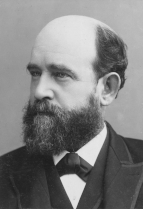
The Henry George Foundation of Canada is part of an international network of organizations that work to popularize the thought of 19th century American economist, Henry George, and which have three goals: a just society, a green society and a prosperous society.
Collectively, these organizations constitute an interconnected think tank advocating financing governments by capturing "economic rent" in lieu of taxes on jobs, business and goods and services.
Economic rent refers to revenue without a corresponding cost of production, the societal surplus or super profits that flow to monopoly held assets like land, resources (oil, copper, trees, water...), the privilege to pollute, the EM spectrum, agricultural supply management quotas, drug patents, taxi medallions, etc.
Though this wealth rightfully belongs to the community, it presently flows mostly untaxed to private asset owners, forcing governments to finance programs by employing economy-damaging taxes on profits, incomes and sales.
This economic theory, often called land value taxation (LVT), is supported by classical economists Adam Smith, David Ricardo, John Stuart Mill, and Henry George, by prominent people like Winston Churchill, Dr. Sun Yet-Sen, Mark Twain, and George Monbiot, and by modern economists Joseph Stieglitz, Milton Friedman, Michael Hudson and Herman Daly.
In his seminal book, Progress and Poverty (1879), Henry George built on the work of Adam Smith, David Ricardo and John Stuart Mill, enumerating the multiple benefits to the economy and society when governments are financed by capturing economic rent.
Taxing incomes makes people more expensive to hire, taxing capital increases the cost of borrowing, taxing profits pushes marginal enterprises closer to bankruptcy, and taxing consumption raises prices. Economists refer to these taxes as dead weight taxes since they stifle economic vitality and exacerbate unemployment and poverty.
Alternately, funding government programs by capturing the community-generated, "unearned income" that accrues to desirable finite assets increases economic efficiency, reduces poverty and unemployment, checks suburban sprawl, conserves resources and minimizes pollution.
Land and natural resources are held in common by the citizenry (and also belong to future generations and other species). When the community approves land ownership or resource access to a business or individual, the community should be recompensed. The dynamism of a particular community or society determines the rental value of local land and resources, so individuals and businesses should not be allowed to pocket the windfall profits that rightfully should accrue to that community. Land value taxation and resource use and pollution charges insure that community-created wealth flows to the community -- above a fair profit of around 5% to the business or individual who, through their labour or ingenuity, has improved the land or added value to a resource.
* Collecting unearned income in lieu of earned income diffuses opposition to paying taxes, since people keep the hard-earned cash earned from jobs and businesses, paying instead only for their privileged access to community-owned assets.
* Collecting economic rent from the relatively few sources is far less complex than taxing millions of jobs, businesses and purchases.
* Infrastructure becomes self-financing since capturing the rise in land value from publicly-funded construction projects is used to finance the projects. Warranted infrastructure returns more than its cost in the form of local land value rise.
* Economic rent capture eliminates real estate speculation, which is the principle cause of recessions and depressions, like the devastating 2008 crash.
* Capturing speculative profits for public purposes gives capital no option but to invest in the productive economy, in labour-intensive production, which raises wages and spawns new businesses.
* LVT is a levy on the privilege of owning land (buildings are ignored by the tax man). Fees are applied equally to vacant and productively used land, reducing the amount of vacant and inefficiently used land. LVT eliminates land speculation since rises in land value are captured by the community, and are no longer available to speculators.
* Land value taxes cannot be evaded, thus eliminating the problems of offshore tax havens, the underground economy, and tax evasion.
Economic rent capture scenarios:
(Under LVT, there are no income, business, or goods and services taxes, and no taxes on buildings or improvements.)
* A residential property is valued at $400,000. The lot and the house are each valued at $200,000. LVT ignores buildings but charges the rental value of the lot, about 5% of market value. The owner is billed $10,000 per year to the municipality.
* A business is situated on 2 acres of land, the parcel market value at $500,000. The owner pays the rental value (5%) or $25,000 in LVT, but no taxes on buildings or income.
* An employee’s gross income is lower, but the net income remains the same since no income taxes are deducted.
* A fixed income senior cannot afford the LVT, so a reverse mortgage is negotiated to defer the LVT till time of sale.
* A student finds inexpensive rental accommodation in a multi-unit building since the building is sited on a small lot and the landlord pays no tax on the value of the building.
* A farmer pays the rental value on a 100 acres valued at $1,000,000, or $50,000 per year, but pays no income taxes or tax on equipment or buildings (improvements), allowing the farmer to hire employees, and build farm labour accommodation, pre and post harvest infrastructure, and farm-gate sales facilities without additional taxes.
* A landlord is motivated to renovate and upgrade a multi-unit building because there are no taxes on materials or labour, nor will taxes increase upon completion, since LVT is levied only against the lot, not the building.
* A carbon fee-and-dividend system is in place to address climate change.
* A buyer negotiates a loan only for the buildings. The land is secured by agreeing to remit the monthly LVT fee.
Economic rent capture has been used effectively in the past and is clearly beneficial in jurisdictions where used today. Alberta and Winnipeg used it in the early 20th century, Japan, Hong Kong and Taiwan are more recent examples, and it is how Sydney paid for their Olympics. Alaska, Alberta, Norway and many other countries use it when collecting resource royalties.
With communism, socialism and Marxism now abandoned in favour of market economics, with interventionist Keynesianism discredited as a long-term solution, and with trickle-down economics mocked as a cynical justification for unconscionable wealth disparity, governments now have the opportunity to return to what Fred Foldvary calls "Foundational Economics", to quash the damaging speculative economy and allow a purely entrepreneurial economy to flourish.